Quarries / Aggregates / Cement
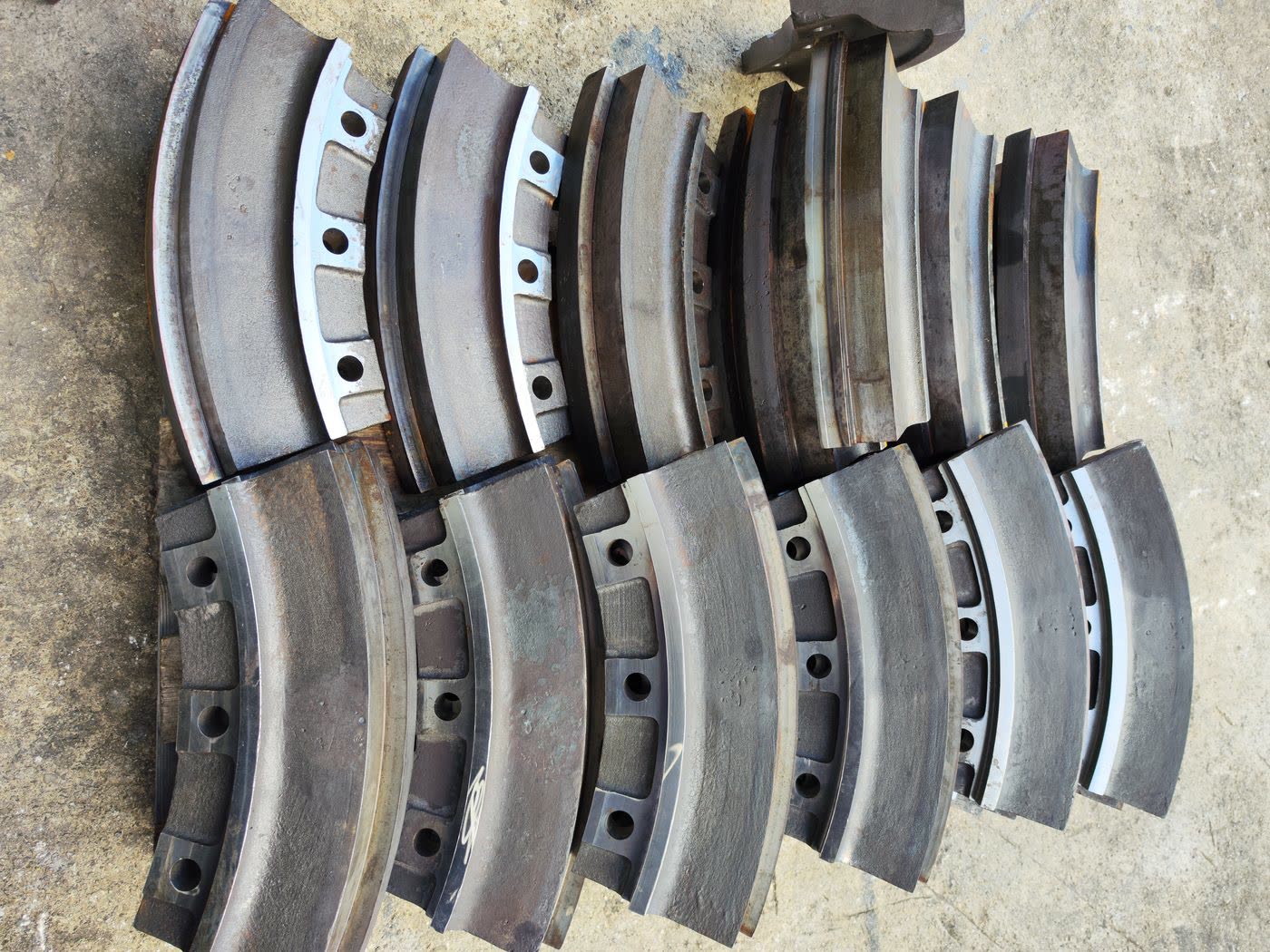
Aggregate processing is a continuous impact-and-abrasion environment, and the wrong alloy costs you tonnes per hour. We have cast crusher wear parts for Greek and international quarries for three generations, and we specify them the way a metallurgist does, not a catalogue.
Six Questions We Ask Every Quarry
The correct alloy depends on your machine, your rock and your operating point. Before proposing a material, our technical team confirms:
Which crushing stage?
Primary, secondary or mill. Each stage has a different impact/abrasion balance and a different correct alloy.
What alloy runs today?
The current grade and its actual service life set the baseline we must beat.
Magnet on the belts?
Tramp metal in the feed changes the impact loading, and the alloy choice.
Happy with the last supplier?
If parts wore fast or fractured, that failure mode tells us what to correct.
What rock, and is it stable?
Abrasiveness and consistency of the deposit drive chromium and manganese levels.
Crusher speed (RPM)?
Rotor speed defines impact energy on hammers and blow bars.
With a worn sample in hand, we also verify the existing chemistry by optical emission spectrometry before we propose anything.
The Right Grade for Each Stage
| Stage | Components | Alloy | Metallurgical Notes |
|---|---|---|---|
| Primary crushing (1st stage) | Jaw plates > ~150 kg · large blades > ~150 kg · large hammers > ~70 kg | Manganese steel GX120Mn12 | C/Mn ratio held at min 1:11, chromium restricted to max 0.5%: maximum impact toughness where the big rock hits first |
| Secondary crushing (feed to ~20 cm) | Medium blades ~80–150 kg · medium hammers ~50–70 kg | GX120MnCr12-2 or GX130MnCr18-2 | C/Mn min 1:10; chromium up to 2.5%: the smaller the blade, the more Cr for wear resistance |
| Tertiary / mills (blades & rotary parts) | Mill blades, rotary wear parts (cones, plates) | High-chrome white iron GX300CrMo15-3 | Chromium up to 27% (GX300CrMo27-1) depending on the rock: maximum abrasion resistance at low impact |
| Mills with hammers | Hammers up to ~30 kg | GX130MnCr22-3 | Manganese up to 22%, chromium up to 3%: toughness plus abrasion resistance for small sections |
| Special cases | Where Mn steel wears fast and chrome iron fractures | Martensitic wear steels | Low-alloy, very low sulfur, multi-stage heat treatment with double quenching: the third way between toughness and hardness |
Process Discipline, Documented
Uniform heat treatment per batch is what gives every casting in a delivery the same wear resistance. That, and in-spec chemistry on every heat, is the whole game in quarry castings. We treat it that way.